



This term a group of Y10 and Y11 had the opportunity to practise their speaking skills and broaden their cultural knowledge of the French-speaking world during a 5-day trip to Morocco. From the busy souks of Marrakesh and the lively Jemaa El-Fna, to the sand dunes and camel rides in Essaouira, students have had a journey filled with new experiences before taking in the breath-taking views from the most beautiful hotel up in the Atlas Mountains.
We have had the most amazing time in Morocco and have made life long memories of such an enriching cultural experience.


Click here to view more photos in the gallery.
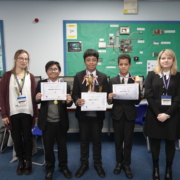
The science department selected 18 students from years 7, 8 and 9 to complete a research project. The Leta Stetter Hollingworth Competition for Biotechnological Inventions was created by University of Birmingham student Alex Ercsei and organized by Mr Hussain.
The students were tasked to look within the Bioscience field to identify a problem faced by humans or other organisms. They would need to research and design a solution, whilst also explaining how it would benefit us all.
The students delivered some excellent presentations on nanotechnology, genetically modified plants, algal based biofuels, vaccines to prevent bioaccumulation and viruses programmed to treat bacterial infections etc.
All students participating did an amazing job and left the expert panel of judges speechless. Thank you to Dr Juliet Cotes and Mr Ahmed for judging and wishing Alex the best of luck in her journey into teaching.
Full list of participants:

Winning Group:
Kieran Hay 8W
Ashfak Nasif 8W
Mohammed Zaman 8W
Click here to view their Biodiversity Pitch Presentation.


At the start of the day, I didn’t know what to expect from the trip to Auschwitz because there is nothing that I could relate it to. Nothing I knew could prepare me for the day which, in a way, made it scary. I think this also points to the fact that the events of the Holocaust seem so inhumane and unnatural that even visiting a site where it took place just over half a century after feels unlike anything.
The day started with a short visit to the Polish town of Oświęcim which was what many know as Auschwitz due to its German translation. It was an interesting first stop which gave us an insight on pre-war life for Jewish people.
After this we went to the Auschwitz concentration camp which was a profound experience. We were given a tour around different buildings in the camp. We were shown rooms with personal belongings, human hair and individual stories which all belonged to victims of the camp. One of the final and most memorable stops was in the room with the ‘book of names’ which I expected to be a big book that could be picked up and looked at but instead it was a double-sided wall of pages the same height as me. I think this was the room I remembered the most because it really put the whole thing into perspective. I knew that millions of people died during the Holocaust, but I had never stopped to think about what millions of individual human lives really looked like and so the book of names really shocked me.
The final stop of the day was the camp of Birkenau which some refer to as Auschwitz 2. This is where the famous picture of the train tracks into the ‘gates of death’ was taken. Birkenau really highlighted the Nazi mistreatment of their mostly Jewish prisoners with them being given animal-like conditions to sleep in. The day finished with a service from a Rabbi who was with us which was very moving and I think it was a solemn yet hopeful way to end the day.
Ben Whiteoak – 12KOR


Even though millions of people lost their lives to the genocide, sometimes it can be easier to leave these events in the past, move on with life and heal the trauma of the incidents with time. However, the lessons of the Holocaust must be taught today as hate and prejudice (foundations of this ethnic cleansing) are still ever-present. The Holocaust highlighted the damning ramifications of permitting hatred of other cultures, religions and livelihoods to grow, leading to the dehumanisation of entire groups of people. For these 17 million people, their hopes, dreams and ambitions were to be unceremoniously lost in their ashes and their entire livelihoods were to be forgotten behind a numerical digit, a death toll.
Something that stuck with me, from the visit to Auschwitz, were the words of Rabbi Marcus. Often people question where God was during such harrowing events but he points towards humans. “Where was MAN?”, he exclaimed. That question is an uncomfortable one. At the end of the day, these murderers were… people. They had families they returned home to, probably played football on weekends and enjoyed drinks with friends. Yet, these are the same people who unleashed 56 tons of Zyklon-B gas on innocent men, women and children. Perhaps this highlights how unchecked hatred can grow, spread and become all-consuming. Maybe this shows that society’s differences are to be embraced, not to break it apart. But certainly, the Holocaust demonstrates that if we don’t live in harmony, if we let intolerance prevail, many will suffer.
Therefore, in current times of an increase in different forms of discrimination together with conflict around the world, it is crucial, now more than ever, to set aside our differences and come together to live happily alongside one another and ensure that such events of the past never happen again.
Shrey Kapoor – 12PSK

Everyone here at KEVI HGS would like to congratulate Lucas Daniels (8N) for his successful recent signing by Coventry City FC Academy.
We all wish him the best of luck with his journey at Coventry City FC Academy and his football career moving forward.


As our Shakespeare season draws to an end, we have had a fantastic final of all of the year group winners who performed speeches from a range of the Bard’s plays.
The recitals were judged by a “celebrity” panel, made up of Mr Kafai, Mrs Harvey and Ms Cutler.
The scores were Ayaan Badre (10 W), 22
Mikaeil Syed (7N), 25
David Daniel (9A), 26
Shrey Kapoor (12 PSK) 27
Oliver Green (12JHI), 29
Sami Khan (8G), 30
Michael white (11W), 30.
So, our joint “Strictly Talk Shakespeare” winners are Sami Khan and Michael White.


