World Book Day 2023 at HGS

World Book Day is an annual event that happens around March. Some people dress up as favourite book characters to celebrate and all students are given a voucher to buy books (which is something I am looking forward to). World Book day is really a spectacular thing but what did HGS to do celebrate it? Here’s a taster so let’s find out!

History

World Book Day is a charity event held annually in the United Kingdom and Ireland on the first Thursday in March. On World Book Day, every child in full-time education in the UK and the Republic of Ireland is provided with a voucher to be spent on books; the event was first celebrated in the United Kingdom in 1998.

The event is the local manifestation of the original, global World Book Day organized by UNESCO to promote reading, publishing, and copyright, and widely observed on 23 April. Organizers in the UK moved the observance to avoid clashes with Easter school holidays and with Saint George’s Day. Book publishers in Ireland decided to bring World Book Day to Ireland a number of years later.

Conversely, the World Book Night event organized by independent charity The Reading Agency is held on 23 April.

What did we do?

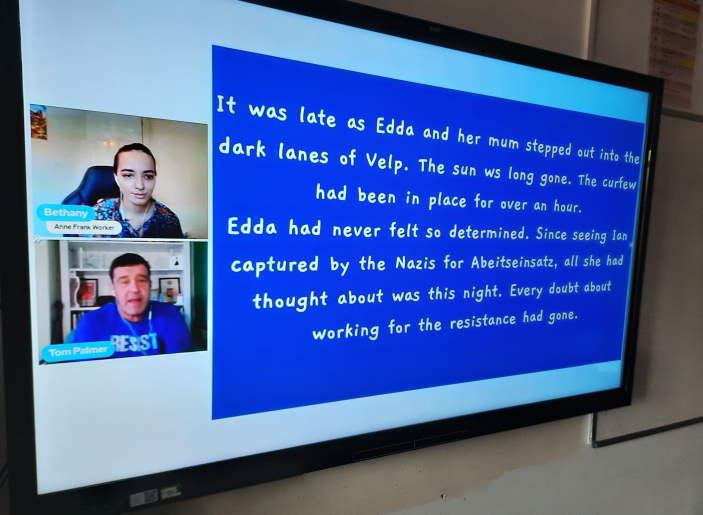
On this special day at HGS, we attended a live virtual event brought to us by Anne Frank Trust, and it was hosted by an author… the great Tom Palmer! Tom Palmer is a popular author at HGS who writes about many subjects, including, football and history too. Much of his writing centres around the impact of World War II. He explores the complexity of war, the politics around war and the suffering children, soldiers and Jewish people experienced at the time. He writes about such issues with aplomb! But before Tom Palmer came on we were greeted by a worker for the Anne Frank Trust, Bethany, who was in London.

The event was truly a global one with people attending from Switzerland, Sweden and even Ohio.

We had a poll about why we celebrate World Book Day and the top answer was to share the joy of reading our favourite books – something we do well at HGS!
Then they started talking about Anne Frank and the legacy her diary left behind.

As some of you know Anne Frank had a diary which has been published all over the world. Bethany read the following extract:

Dear Kitty,
“Writing in a diary is a really strange experience for someone like me. Not only because I’ve never written anything before, but also because it seems to me later on neither I nor anyone else will be interested in the musings of a thirteen year old girl.”

After this, Tom Palmer went on and read us an extract of his new book: Resist. It turns out it’s about a girl whose only passion is to dance but she can’t, nobody can as the Nazi’s have seized their country and they could be sent to camps if seen out, but she decided to risk it all by dancing at a secret event to raise money and help the resistance against the Germans. The girl is none other than Audrey Hepburn!

In all honesty, this was a really interesting event for us here at HGS. The impact books can have on people, the narratives they communicate to future generations and emotional rollercoasters they can provide will probably be something we won’t forget.

Thanks for reading this!
Gabby (7W)


HGS E-Newsletter (03-03-23)

Focus on Education March 2023

 “The Babel fish is small, yellow, leech-like, and probably the oddest thing in the Universe. It feeds on brainwave energy received not from its own carrier, but from those around it. It absorbs all unconscious mental frequencies from this brainwave energy to nourish itself with. It then excretes into the mind of its carrier a telepathic matrix formed by combining the conscious thought frequencies with nerve signals picked up from the speech centres of the brain which has supplied them.

The practical upshot of all this is that if you stick a Babel fish in your ear you can instantly understand anything said to you in any form of language. The speech patterns you actually hear decode the brainwave matrix which has been fed into your mind by your Babel fish.

The poor Babel fish, by effectively removing all barriers to communication between different races and cultures, has caused more and bloodier wars than anything else in the history of creation.”

This description of the Babel Fish, comes from the Hitchhikers Guide to the Galaxy written in 1979 by Douglas Adams.

I am now going to do something that I have never done before and thus is a first for me and I suspect might well be a last too:

AI, or Artificial Intelligence, is a form of intelligence exhibited by machines and computer systems. AI mimics cognitive functions such as learning, problem solving, and pattern recognition that are associated with the human mind. AI systems are able to perform tasks such as object recognition, natural language processing, facial recognition, and many more. AI has applications in a wide range of areas including healthcare, manufacturing, research, education, and finance. AI is revolutionizing the way we interact with technology and has the potential to greatly improve our daily lives.

What is so special about that, you may ask? Well, that paragraph was generated in response to the request to explain AI in 100 words…and the request was made to Chatgpt which used artificial intelligence to generate that answer. Until this weekend, I had never used a chatbot before and certainly not to generate one hundred words of a Focus on Education.

The next bit really is me: You will have read the speculation that AI used in this way is both a great thing because users can receive quick answers to questions in the form that they want….and then also the speculation that it will lead to cheating, with students trying to pass off chatbot answers as their own with a huge increase in cases of exam candidates being disqualified for plagiarism.

My personal view is that chatbots will not bring about the end of homework, or writing tasks but they may bring changes. Already, I understand that the output from chatbots will be watermarked so it can be easily detected by software designed to check for plagiarism, so none of us must try to pass chatbot answers off as our own. It may be that the type of tasks that students are set will call for a more personal response but the skill of learning to set out our own thoughts in a well-crafted structured piece of writing, is an important one. It takes time to develop our own style and whilst AI may help us, I do not think it will ever lessen the importance of us learning to independently convey our own understanding in our own words.

However, the extent of the usefulness of AI is yet to be seen. How it helps or hinders us in school and in our wider lives will undoubtedly unfold and so will the changes that come with it. And that has always been the case with technology. Either deliberately or sometimes by accident, individuals have found ways to use science to solve problems. So, for example, Alexander Fleming hadn’t cleaned his petri dishes properly when he left his lab for a holiday. On his return he discovered a mould growing on them but no bacteria was growing around the mould – the mould had killed it. In a clean petri dish, he then grew the mould again- and found that it produced a substance that killed lots of bacteria which we now know as Penicillin, because it is produced by the Penicillium group of moulds. By accident, he had stumbled across Penicillin which has helped to save the lives of huge numbers of people who would otherwise have died from what are now treatable infections.

But those who I particularly admire are the individuals who imagine solutions to problems long before the technology exists to deliver them. Some of you will have read the Hitchhiker’s Guide to the Galaxy, written in 1979 by Douglas Adams. Two characters, Arthur Dent and Ford Prefect are travelling through the universe and come across Babel fish – named after the Tower of Babel in the Bible which supposedly explains why people across the world speak different languages. However, in his story written 44 years ago, Douglas Adams imagined a fish which when placed in the ear has the ability to let the user understand anything said in any form of language, so removing any barriers to communication anywhere in the Universe. 44 years on, I gather scientists have invented earbuds which connect with a phone and will deliver a translation of choice into a user’s ear…a more animal-friendly version of the Babel fish perhaps?

Some of you will spend your lives exploring the science that make these things possible. Others will use the science to develop technological solutions to solve problems – occasionally problems that some of us did not know we had. Being a Force for Good is the important thing. However, the lives of all of us will evolve in response to technology and I think that has always been the case.

Finally, I leave you with this from the chatbot – you can guess the question.

No, artificial intelligence will not replace Headmasters. Headmasters provide an important role of leadership and guidance in schools, and this is something that AI cannot replace. AI can help with some administrative tasks and provide support to teachers, but it will not be able to provide the same level of guidance as a Headmaster.

I hope it is right….

Stay safe and well.

Be kind to yourself and others.

Best wishes,

Dr Bird

Wellbeing Advice