


Geography
Staff
| Mr S A Thaper | Head of Geography |
| Mr D Bird | Assistant Headteacher (Post 16) |
| Miss E L Morgan | Head of Year 10 |
| Mr A J R Sanders | EPQ Co-ordinator |
Geography at King Edward VI Handsworth Grammar School
Geography at King Edward VI Handsworth Grammar School provides young people with a unique insight into the workings of our planet and the relationships between people, places and environments.
Our ambition is to develop knowledgeable, curious and critical geographers who can understand the complex and rapidly changing world around them. Geography provides students with the opportunity to explore real issues, both global and local, and gives them the knowledge, confidence and geographical understanding to develop their own informed perspectives.
We want Geography to help our students become confident, able and responsible learners who are equipped not only to succeed academically, but also to make informed decisions and become a force for good in the world.
Our curriculum is knowledge-rich and develops four interconnected forms of geographical knowledge:
- Substantive knowledge: understanding people, places, environments and geographical processes.
- Disciplinary knowledge: understanding how geographers investigate the world through fieldwork, geographical enquiry, maps, graphs, GIS, photographs, statistics, models and decision-making.
- Personal knowledge: enabling students to connect Geography with their own experiences, their local area and their cultural heritage.
- Powerful knowledge: enabling students to understand unfamiliar places, recognise the importance of scale and consider how our own experiences can influence our perceptions of the world.
Throughout their geographical journey, students develop their ability to explain processes, analyse evidence, evaluate different perspectives and communicate increasingly sophisticated geographical arguments.
Fieldwork, geographical enquiry, extended writing and the application of knowledge are therefore integral to Geography at HGS.
Course Calendars
Please click here to view the Year 7 Course Calendar
Please click here to view the Year 8 Course Calendar
Please click here to view the Year 9 Course Calendar
Please click here to view the Year 10 Course Calendar
Please click here to view the Year 11 Course Calendar
Please click here to view the Year 12 Course Calendar
Please click here to view the Year 13 Course Calendar
Geography at Key Stage 3
Our Key Stage 3 curriculum establishes the strong foundations of knowledge, vocabulary and geographical skills that students need to understand the world around them and to succeed in their future study of Geography.
The curriculum deliberately begins with an in-depth study of the United Kingdom. Our experience of assessing students when they arrive at HGS has shown the importance of establishing secure knowledge of their own national geography before progressively expanding their geographical horizons.
Year 7
Students study:
- Introduction to the UK
- Physical Landscapes in the UK
- Weather and Climate in the UK
Students explore a combination of human and physical Geography centred around the United Kingdom. This enables them to consolidate existing knowledge, address misconceptions and develop a secure geographical familiarity with the UK before moving beyond its borders.
The increased curriculum time allocated to Geography in Year 7 allows students to explore key concepts in greater depth, strengthen their geographical skills and address misconceptions more effectively.
Year 8
Students study:
- People of the UK
- Work, Rest and Play in the UK
- Challenges and Opportunities in the UK
- Our Physical World
- Our Living World
During Year 8, students progressively move from a UK-focused curriculum towards a broader exploration of the world.
Our curriculum reflects the diverse experiences and backgrounds of our students while deliberately broadening their geographical horizons. Students encounter contrasting places and perspectives so that they can compare their own experiences with those of people living in different environments and communities.
Year 9
Students study:
- Our unequal World
- Focus on Africa
- World Cities
- World Issues
In Year 9, students encounter broader and increasingly complex geographical issues. Their understanding of human and physical Geography is brought together as they consider places, processes and challenges at a global scale.
This provides important preparation for the greater depth, application and synoptic thinking required at GCSE and beyond.
Assessment at Key Stage 3
Assessment is an important part of students’ geographical development. Students complete a formal assessment at the end of each unit and are given opportunities to reflect upon their performance and identify individual areas for improvement.
Assessment increasingly requires students not simply to recall knowledge, but to apply it. Students develop their ability to interpret geographical information, explain processes, use evidence and construct extended geographical arguments.
Geography at Key Stage 4
Specification: AQA GCSE Geography (8035)
The Course
GCSE Geography challenges students to investigate some of the most significant human and physical processes shaping our planet.
Students study contrasting places and environments at a variety of scales while considering the complex relationships between people and the natural world.
Our GCSE curriculum builds directly upon the knowledge established at Key Stage 3. An interleaved approach enables students to revisit previous learning, make connections between different areas of Geography and increasingly apply their knowledge to unfamiliar geographical contexts.
Alongside developing secure geographical knowledge, particular emphasis is placed upon geographical skills, examination technique and extended writing. Students learn to select relevant evidence and use their knowledge to construct increasingly sophisticated geographical arguments.
The Content
Paper 1: Living with the Physical Environment
- The Challenge of Natural Hazards
- The Living World
- Physical Landscapes in the UK
Paper 2: Challenges in the Human Environment
- Urban Issues and Challenges
- The Changing Economic World
- The Challenge of Resource Management
Paper 3: Geographical Applications
- Issue Evaluation
- Fieldwork
- Geographical Skills
GCSE Fieldwork
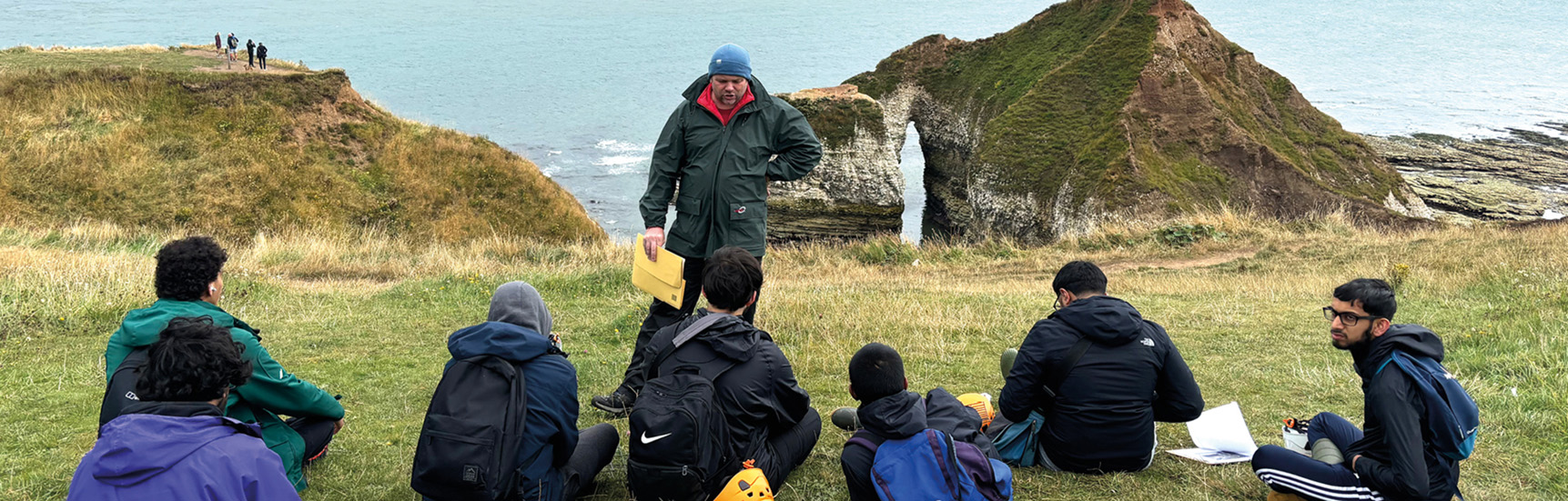
Fieldwork is fundamental to Geography because it allows students to investigate geographical questions beyond the classroom and apply their knowledge to real environments.
At GCSE, students undertake two days of compulsory geographical fieldwork. This is completed through a residential in Year 10.
Through geographical enquiry, students develop their ability to collect and present primary data, analyse geographical patterns, reach evidence-based conclusions and critically evaluate investigative methods.
Fieldwork consequently enables students to experience Geography as a practical discipline rather than simply a classroom subject.
GCSE Geography Results 2026
In Summer 2026, students achieved strong outcomes in GCSE Geography:
- 45.3% achieved Grades 9–7
- 92.5% achieved Grades 9–5
- 98.1% achieved Grades 9–4
- 100% achieved Grades 9–1
Students performed above the national average across all three examination papers:
- Paper 1: Physical Geography: HGS 60.6% | National 50.2%
- Paper 2: Human Geography: HGS 69.7% | National 52.3%
- Paper 3: Geographical Applications: HGS 64.4% | National 51.0%
Geography at Key Stage 5
Specification: AQA A Level Geography
A Level Geography bridges the social and natural sciences and provides students with the opportunity to explore some of the most complex relationships between people, places, environments and physical processes.
The course is divided between human and physical Geography, with modules taught by subject specialists. Our curriculum enables students to build upon prior geographical knowledge while encountering increasingly complex theories, examples and geographical perspectives.
Students are expected to think critically, consider competing explanations, analyse geographical evidence and construct well-supported academic arguments.
As students progress through the course, increasing emphasis is placed upon synoptic thinking and extended writing. By Year 13, students are expected to draw together knowledge from across the course and apply it confidently to complex geographical questions.
The Content
Physical Geography
- Water and Carbon Cycles
- Hazards
- Coastal Systems
Human Geography
- Global Systems and Global Governance
- Changing Places
- Population and the Environment
A Level Assessment
A Level Geography comprises two examinations and a Non-Examined Assessment.
Paper 1: Physical Geography
2 hours 30 minutes
Paper 2: Human Geography
2 hours 30 minutes
Together, the two examinations account for 80% of the A Level qualification.
Non-Examined Assessment
The Non-Examined Assessment accounts for 20% of the A Level qualification and provides students with the opportunity to undertake an independent geographical investigation.
Students identify an area of Geography that interests them, develop a suitable geographical enquiry and undertake independent research and data collection.
The investigation develops valuable skills in geographical enquiry, research, data analysis, academic writing, critical thinking and evaluation.
A Level Fieldwork
Students undertake four days of compulsory fieldwork as part of their A Level Geography course.
Fieldwork develops students’ understanding of how geographical knowledge is created. Students gain first-hand experience of designing enquiries, selecting appropriate methodologies, collecting primary data and evaluating the strengths and limitations of geographical research.
These experiences also provide an important foundation for students’ independent investigations.
Entry Requirements
GCSE Geography: Grade 6 or above
A Level Geography Geography Results 2026
Our A Level Geography students achieved strong outcomes, with an average grade of B and a 100% pass rate.
- 37.5% achieved grades A–A*
- 62.5% achieved grades A–B*
- 87.5% achieved grades A–C*
- 100% achieved grades A–E*
Students also performed above the national average in both examined components:
- Paper 1: Physical Geography: HGS 63.9% | National 61.5%
- Paper 2: Human Geography: HGS 63.0% | National 61.8%
Learning beyond the classroom
We believe strongly that Geography should extend beyond the classroom.
Students are provided with opportunities to experience Geography first-hand through fieldwork, educational visits, enrichment and wider geographical experiences. The department aims to provide opportunities ranging from domestic fieldwork to international experiences.
These opportunities enable students to encounter the places, processes and issues they study in the classroom while developing their independence, curiosity and understanding of the wider world.
Our students are also encouraged to consider the contribution they can make to society. Geography provides opportunities for students to connect their learning with their responsibilities as members of local, national and global communities.
Super-curriculum
Students are encouraged to extend their geographical understanding beyond their lessons through wider reading, independent research and engagement with contemporary geographical issues.