


Science
Staff
- Since 2010 Mr F Ahmed: B.Sc., M.Ed. (B’ham), P.G.C.E.,: Head of Science, Biology and Enrichment
- Since 2013 Ms M Bilkhu: B.Sc.(Aston), P.G.C.E.(B’ham): Head of Chemistry
- Since 2019 Mr T Bennett: M.Sci., M.Res. (B’ham), P.G.C.E.: Head of Physics
- Since 2018 Mr Z Hussain: B.Sc. (Coventry): Senior Science Laboratory Technician
- Since 2025 Mrs N Hayat: A., M.A., Science Laboratory Technician
- Since 2000 Miss M Hurley: B.Sc., M.Sc. (B’ham), P.G.C.E.: Biology, Assistant Head of Sixth Form – Head of Year 12
- Since 2015 Mr J Hussain: B.Sc. (Aston), P.G.Dip.Ed. (B’ham): Biology/ Head of Year 7
- Since 2015 Miss T Saleem: B.Sc. (Aston), P.G.C.E.: Biology/Head of Year 11
- Since 2026 Dr S Villatorro-Martin: BSc (Sheffield), MSc (Sheffield Hallam), PhD (B’ham), P.G.C.E : Chemistry
- Since 2012 Mr D Bansal: B.Sc. (De Montfort), P.G.C.E.: Chemistry, Head of Year 9
- Since 2005 Mr I Bedi: B.Sc. (Huddersfield), P.G.C.E.: Chemistry (part-time)
- Since 2009 Mrs N Begum: B.Sc. (Wolverhampton), P.G.C.E.: Chemistry, Assistant Headteacher: Teaching and Learning
- Since 2011 Mr M Mohsin: B.Sc. (Aston), P.G.C.E.: Chemistry/Physics, Assistant Headteacher (Student Support 11-16)/Staff Governor
- Since 2024 Mr S Hastings: B.Sc. (B’ham), P.G.Dip.Ed. (KEC).
- Since 1986 Mr P Jones: B.Sc. (B’ham), P.G.C.E. (Nott’m), C.Phys., M.Inst.P.: Physics (part-time)
- Since 2023 Mr S Patrick: B.Sc. (BCU), P.G.Dip.Ed. (B’ham): Physics, Head of Year 8
- Since 2021 Miss E Morgan: B.Sc. (B’ham), P.G.C.E.: Geography/KS3 Science/Head of Year 10
- Since 2024 Miss C Zetu: B.Sc. (Aston), P.G.C.E: Computing/KS3 Science

Aims
The Science Faculty’s vision is to provide every student with a science education that stimulates their curiosity and develops their self-belief and self-confidence.
The Science Faculty’s aims are to
- provide a supportive and caring environment which fosters in our students a desire to learn, enjoy and challenge themselves to achieve across all disciplines of science.
- enthuse our students through teaching science in an interesting, informative and interactive manner, providing our students with opportunities to develop a wide range of skills, in line with the ‘Building Learning Habits’ agenda.
- deliver effectively the National Curriculum and the requirements of Post-16 specifications, and, through support and challenge, enable each student to realise his or her full potential.
- encourage our students to become informed and aware members of society, able to formulate and communicate their own opinions and judgements about developments in science, and evaluate critically scientific claims.
- develop our students’ application of observational, practical, enquiry and problem-solving skills and understanding within the laboratory and other learning environments.
- develop our students’ ability to assess potential risk.
Curriculum
- Course Calendars
- For details about topics teaching order and assessments for Years 7-13 (Biology, Chemistry & Physics) then click here: Course Calendars
- Curriculum Topic Summaries:
- Curriculum Progression Grids:
- For Knowledge, Retrieval and Practice resources available to students/staff follow this link.
- Going Beyond the Curriculum in Science follow this link
My Super Curricular
Please see the course calendar for the mapped out Super Curriculum across all Key Stages.
You can access the resources for the mapped out Super Curriculum here.


Key Stage 3
Extra Key Stage 3 course information for the current Years 7, 8 and 9 can be found from the following link:
The Key Stage 3 course follows the KS3 National Curriculum guidelines and uses the SMART Activate Oxford Programme as its basis. It is taught during Years 7, 8 and 9 with Biology, Chemistry and Physics being taught under the umbrella of ‘Science’ in Years 7 and 8 only; students are taught in tutor groups. This is taught over 8 periods per fortnight. The rationale here is to aid their integration into secondary school following their progression from KS2 to KS3, which is a big jump for many given the low-profile Science receives, in some schools, at KS2.
In Year 9, students are split into ability bands and are taught ‘separate’ Biology, Chemistry and Physics by subject specialists. Each subject is taught for 4 periods per fortnight in Year 9 so giving a total of 12 periods of ‘Science’ (going to 5 periods per fortnight in Years 10 & 11). This curriculum design enables us to integrate teaching certain GCSE topics at KS3 (in Year 9) and continue the curriculum progression into full GCSE at KS4 in Years 10 & 11. This is done by developing topics (first taught at KS3) further by way of building on the detail of, and making visible, the connections between the various topics, which encourages students to see the big picture through the cross-curricular connections.
Topics covered are:
YEAR 7
Biology
- Cells
- Structure and function of body systems
- Reproduction
Chemistry
- Particles and their behaviour
- Elements, atoms and compounds
- Reactions
- Acids and alkalis
Physics
- Forces
- Sound
- Light
- Space
YEAR 8
Biology
- Health and lifestyle
- Biological processes
- Ecosystems and Adaptation
- Inheritance
Chemistry
- The periodic table
- Separation techniques
- Metals and acids
- The Earth
Physics
- Electricity and magnetism
- Energy
- Motion and pressure
YEAR 9
Biology
- Cell structure and transport
- Cell division
- Organisation and the digestive system
- Organising animals and plants
- Communicable diseases
- Preventing and treating diseases
- Non-communicable diseases
Chemistry
- Atomic structure
- Structure and bonding
- Chemical changes
- Crude Oil and Fuels
- The periodic table
Physics
- Conservation and dissipation of energy
- Energy transfer by heating
- Molecules and matter
- Wave properties
- Electromagnetic waves
- Energy resources
Students will be placed in one of five sets based upon their Year 7 and 8 test and examination performances, with sets 1-3 being parallel sets (top band) made up of the top 60% of the year group and sets 4 and 5 are parallel sets (lower band) made up from the remaining students. All students will cover the same material in Year 9.
Assessment Schedule
Formal assessment is by means of end-of-topic tests and an end-of-Year 8 examination. The assessment data will be used to put students into broad ability bands for their Biology, Chemistry and Physics sets in Year 9.
The end-of-year 9 examination is used to determine the students KS4 sets in Year 10 (going from 5 sets in Year 9 to 6 sets in Year 10).
Support materials
Students have access to bespoke electronic textbooks for their Science courses on www.kerboodle.com, together with other resources on the school Virtual Learning Environment (VLE) via MS Teams. Additionally, students have access to high quality teaching PowerPoints, simulations and a myriad of quizzes with automatic marking on Educake.co.uk and www.senecalearning.com and www.cognito.org To help develop our students’ examination techniques, students are regularly afforded the opportunity to complete past examination-style questions (on SATS-style papers). Many parents ask about any additional books that may be useful; we recommend the following:
- CGP – KS3 Science Workbook (Higher)
- CGP – KS3 Science Revision and practice (Higher)
These can be purchased from WHSmith’s stores, Waterstones, Amazon etc or directly from www.cgpbooks.co.uk.
Key Stage 4
Extra Key Stage 4 course information for the current Years 10 and 11 can be found from the following links:
All students embarked upon the study of their GCSEs in Science subjects at KS3, particularly at the start of Year 9. They have had 4 periods in each of Biology, Chemistry and Physics per fortnight, rising to 5 periods per fortnight in Years 10 and 11. In year 10 students continue the curriculum progression into full GCSEs. The courses are based upon the AQA Specifications, and final assessments will be by means of a series of terminal question papers (at the end of year 11) which contain a variety of question styles. As part of the course, students will perform or observe a number of ‘required practicals’ (in addition to usual practical work); some examination questions will be related to these. There is no coursework component in any Science GCSEs.
Subject content is as follows:
Biology
- Cell Biology
- Organisation
- Infection and response
- Bioenergetics
- Homeostasis and response
- Inheritance, variation and evolution
- Ecology
Chemistry
- Atomic structure and the periodic table
- Bonding, structure and the properties of matter
- Quantitative chemistry
- Chemical changes
- Energy changes
- The rate and extent of chemical change
- Organic chemistry
- Chemical analysis
- Chemistry of the atmosphere
- Using resources
Physics
- Forces
- Energy
- Waves
- Electricity
- Magnetism and electromagnetism
- Particle model of matter
- Atomic structure
- Space Physics (not for Combined Science)
Assessment schedule
Students have now sat their internal Year 9 ‘Finals’ examinations in each of Biology, Chemistry and Physics. These are in addition to the shorter Assessment Tests which have taken place during the year.
In Year 10, students are placed in broad ability bands, with (‘parallel’) Sets 1-3 being comprised of students who performed particularly well in their Year 9 Science examinations. Sets 4 and 5 are also two ‘parallel’ sets and Set 6 is a smaller set made up of students whose examination performances suggest that they would benefit from a higher level of individualised support. All students will follow the same programme in Year 10. The programme then followed by students in Year 11 will depend upon their performances in the end-of-Year 10 examinations and their mock examinations (taken in January of Year 11): they will either be entered for Separate Sciences or Combined Science: Trilogy
Separate Science route
Those students who perform well in the assessments will continue to follow a programme leading to the award of GCSE Biology, Chemistry and Physics. They will sit two 1 hour 45 minute papers in each Science subject, each paper being worth 100 marks and consisting of multiple choice, structured, closed short answer and open-response questions. We expect that most students will follow this programme.
Combined Science route
Some students’ performances may indicate that it will be in their interests for them to be prepared for entry into GCSE Combined Science: Trilogy instead of the separate Sciences. This is a double award qualification; it is worth two GCSEs. Students will sit two 1 hour 15 minute papers in each Science subject, each paper being worth 70 marks and consisting of multiple choice, structured, closed short answer and open-response questions. As there is less content to be covered, there will be more time to consolidate and revise material during lessons. It should be noted that this route also allows students to embark upon the study of A levels in Biology, Chemistry and Physics.
Support materials
Students have access to bespoke electronic textbooks for their Science courses on www.kerboodle.com, together with other resources such as Seneca, Cognito and Educake. Students have had the opportunity to purchase ‘hard’ copies of these textbooks at a discounted rate through the school; they are also available in the shops – look for Oxford separate GCSE Biology, Chemistry and Physics books, or the GCSE Combined Science: Trilogy books. Students can view and download the specification(s) and information about the courses from the website www.aqa.org.uk. Specimen and past examination papers are also available on the AQA website.


Key Stage 5 Biology

Why study Biology?
Biology is the study of living things. It is a multi-disciplinary subject that includes such varied topics as Human Physiology, Genetics, Biochemistry, Ecology and Disease.
Biology is a popular choice at ‘AS’ and ‘A-level′ with there usually being four sets in Year 12 and four in year 13. The courses are based on the AQA Specification. These specifications, together with past papers and mark-schemes, are available on the AQA website (www.aqa.org.uk).
Possible degree options
Essential and Healthcare Degrees
- Medicine
- Dentistry
- Veterinary Science
- Pharmacy
- Biomedical Science
- Nursing and Midwifery
- Physiotherapy and Occupational Therapy
- Optometry
Biological and Life Sciences
- Biological Sciences (BSc / MSci)
- Biochemistry and Molecular Biology
- Genetics
- Microbiology and Immunology
- Pharmacology and Biotechnology
- Zoology and Marine Biology
- Botany and Ecology
Environmental and Applied Sciences
- Conservation Biology
- Forensic Science
- Sport and Exercise Science / Sports Science
- Psychology (often accepted as a science or social science that complements biology well)
- Agriculture, Forestry, and Food Science
You can check specific entry tariffs and subject combinations using the The Uni Guide A-Level Explorer or browse broader degree listings via Uni Compare. Note that competitive courses like Medicine or Dentistry will almost always require A-level Chemistry alongside Biology
Qualifications needed to study A-Level Biology
Students must have achieved at least a grade 7 in GCSE Biology. If a student has studied GCSE Combined Science rather than separate sciences they will require a minimum of two grade 7s and will only be permitted to choose a maximum of 2 Sciences for A-level.


Year 12 Course Structure
Year 12 Subject content:
- Chapter 1 – Biological molecules
- Chapter 2 – Nucleic acids
- Chapter 3 – Cell structure
- Chapter 4 – Transport across cell membranes
- Chapter 5 – Cell recognition and the immune system
- Chapter 6 – Organisms exchanging substances with their environment
- Chapter 7 – Mass Transport
- Chapter 8 – DNA, genes and protein synthesis
- Chapter 9 – Genetic diversity
- Chapter 10 – Biodiversity
- Chapter *13 – Energy and ecosystems
- Chapter *19 – Populations and ecosystems
*These are Year 13 topics that we teach at the end of Year 12 to prepare students to complete the fieldwork (required practical 12).
Practicals:
Biology, like all sciences, is a practical subject. Throughout the course students will carry out practical activities including:
- Required practical 1 – Investigation into the effect of a named variable on the rate of an enzyme-controlled reaction (The effect of temperature on the rate of the reaction catalysed by trypsin).
- Required practical 2 – Preparation of stained squashes of cells from plant root tips; set-up and use of an optical microscope to identify the stages of mitosis in these stained squashes and calculation of a mitotic index (Root tip squash using onion root meristem tissue).
- Required practical 3 – Production of a dilution series of a solute to produce a calibration curve with which to identify the water potential of plant tissue (Determining the water potential of potato tuber cells).
- Required practical 4 – Investigation into the effect of a named variable on the permeability of cell-surface membranes (The effect of alcohol concentration on the leakage of pigment from beetroot cells).
- Required practical 5 – Dissection of animal or plant gas exchange or mass transport system or of organ within such a system (Heart dissection)
- Required practical 6 – Use of aseptic techniques to investigate the effect of antimicrobial substances on microbial growth (Aseptic technique producing bacterial plates and use of mast ring of antibiotics)
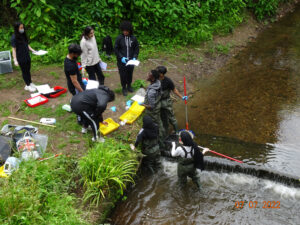
- Required practical 12 – Investigation into the effect of a named environmental factor on the distribution of a given species (The effect of [water depth/flow] on the distribution of [named species]).
These practicals will give students the skills and confidence needed to investigate the way living things behave and work. It will also ensure that if a student decides to study a Biology-based subject at university, they will have the practical skills needed to carry out successful experiments at degree level.
To aid with conduct of the fieldwork practical (required practical 12), students are given a choice of a one day field studies trip or a 3 days residential trip to Wales.
One day field trip to Cannon Hill Park (Birmingham)

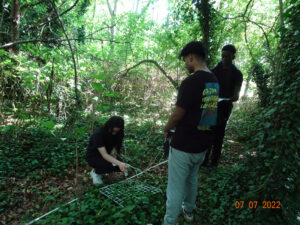


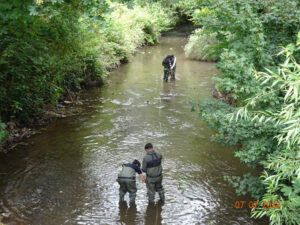


3 days residential trip to Margam Discovery Centre (Wales)


Assessment:
There is no coursework on this course. However, students’ performance during practicals will be assessed by means of two 1 ½ hour written examinations taken in May/June of Year 12. In addition, teachers will formally assess students against a set of five practical competencies to determine if students have carried out the practical activities correctly and safely.
More details about course content can be found from the following link: A-level Biology 7402 | Specification | Subject Content | AQA
Haemochromatosis Society Conference
Group Interview
Interview with Pavan Chahal
Year 13 Course Structure
Year 13 Subject content:
- Chapter 11 – Photosynthesis
- Chapter 12 – Respiration
- Chapter 14 – Response to stimuli
- Chapter 15 – Nervous coordination and muscles
- Chapter 16 – Homeostasis
- Chapter 17 – Inherited change
- Chapter 18 – Populations and evolution
- Chapter 20 – Gene expression
- Chapter 21 – Recombinant DNA technology
Practicals:
Biology, like all sciences, is a practical subject. Throughout the course students will carry out practical activities including:
- Required practical 7 – Use of chromatography to investigate the pigments isolated from leaves of different plants g. leaves from shade-tolerant and shade- intolerant plants or leaves of different colours.
- Required practical 8 – Investigation into the effect of a named factor on the rate of dehydrogenase activity in extracts of chloroplasts (The effect of ammonium hydroxide on the time taken for chloroplasts to decolourise DCPIP).
- Required practical 9 – Investigation into the effect of a named variable on the rate of respiration of cultures of single-celled organisms (An investigation of the effect of temperature on respiration in yeast).
- Required practical 10 – Investigation into the effect of an environmental variable on the movement of an animal using either a choice chamber or a maze (effect of light/dark, humid/dry conditions on the movement of maggots in a choice chamber.).
- Required practical 11 – Production of a dilution series of a glucose solution and use of colorimetric techniques to produce a calibration curve with which to identify the concentration of glucose in an unknown ‘urine’ sample
These practicals will give students the skills and confidence needed to investigate the way living things behave and work. It will also ensure that if a student decides to study a biology-based subject at university, they will have the practical skills needed to carry out successful experiments at degree level.

Assessment:
There is no coursework on this course. However, students’ performance during practicals will be assessed by means of three 2 hour written examinations taken in May/June of Year 12. In addition, teachers will formally assess students against a set of five practical competencies to determine if students have carried out the practical activities correctly and safely.
More details about course content can be found from the following link:
http://www.aqa.org.uk/subjects/science/as-and-a-level/biology-7401-7402
How is the course delivered?
Study of Biology in the Sixth Form involves a variety of learning experiences including teacher and student presentation, interactive computer programmes, internet research, class discussion, teacher demonstration and class practical work. Question sheets and Biofactsheets to consolidate knowledge and understanding are provided on a regular basis and student progress is monitored through regular assessment tests. Students benefit from access to a variety of on-line tools such as ‘Kerboodle’, ‘Educake’ and ‘Cognito’ as well as a wealth of resources on MS Teams for consolidation and extension.
A wider interest in Science is also encouraged; students should aim to keep abreast of current developments through reading relevant articles on the internet or in the press or scientific magazines e.g. New Scientist, Nature and the Biological Sciences Review which are available in both in the Science Department and in the School Library. Students are encouraged to take out a subscription for the Biological Sciences Review, a quarterly journal published to support the A level Biology curriculum. Ecology field work has always been an important part of the curriculum.


National competitions:
Students are encouraged to participate in the prestigious British Biology Olympiad (Years 12 & 13); Intermediate Biology Olympiad (Year 12).
Super Curriculum:
Our the course calendars have a dedicate section to suggested super curricular activities that students can engage with such as the aforementioned competitions, recommended reading lists, podcasts and videos, and more such as the annual competitions organised by the Royal Society of Biology.
Key Stage 5 Chemistry
Why study Chemistry?
Chemistry is a very popular choice at ‘AS’ and ‘A2′ levels with their usually being 4/5 sets in Years 12 and 3 sets in yr13. The courses are based on the AQA Specifications and these, together with past papers and mark schemes, are available on the AQA website.
The course builds upon the knowledge and understanding of the GCSE course. It helps to develop many skills including thinking and practical and is recognised as a valuable subject by employers in all fields.
Qualifications needed to study AS/A2 Chemistry
Students must have achieved at least a grade 7 in GCSE Chemistry, or grades 7, 7 at least ins GCSE Combined Science or acceptable alternatives, in addition to meeting the general entry requirements for the Sixth Form.
AS Course Structure – New Course, Year 12
Subject content:
- Atomic structure
- Amount of substance
- Bonding
- Energetics
- Kinetics
- Equilibria
- Oxidation, reduction and redox reactions
- Periodicity
- Group 2 Alkaline Earth Metals
- Group 7, the Halogens
- Introduction to organic chemistry
- Alkanes
- Halogenalkanes
- Alkenes
- Alcohols
- Organic Analysis
- Mathematical skills
- Practical skills
Practicals:
Chemistry, like all sciences, is a practical subject. Throughout the course you will carry out required practical activities including:
- Making up a volumetric solution and carrying out a titration.
- Measuring an enthalpy change.
- Investigation of how the rate of reaction changes with temperature.
- Carrying out test-tube reactions to identify cations and anions in aqueous solutions
- Distillation of a product from a reaction.
- Tests for an alcohol, aldehyde, alkene, and a carboxylic acid.
Assessment:
There is no coursework on this course. However, your performance during practicals will be assessed. Assessment is by means of 3 assessments throughout the year and a final exam towards the end of July. These assessments are important as they will decide predicted grades for University courses.
More details about course content can be found from the following link:
http://www.aqa.org.uk/subjects/science/as-and-a-level/chemistry-7404-7405

A2 Course Structure – New Course, Year 13
Subject content:
- Thermodynamics
- Kinetics
- The equilibrium constant Kp
- Electrode potentials and electrochemical cells
- Acids, bases and buffers
- Periodicity
- The transition metals
- Reactions of inorganic compounds in aqueous solutions
- Nomenclature and isomerism
- Compounds containing and carbonyl group
- Aromatic chemistry
- Amines
- Polymerisation
- Amino acids, proteins, and DNA
- Organic synthesis and analysis
- Structure determination
- Chromatography
- Mathematical skills
- Practical skills
Practicals:
Chemistry, like all sciences, is a practical subject. Throughout the course students will carry out practical activities including:
- Measuring the rate of reaction
- By an initial rate method
- By a continuous monitoring method
- Measuring the EMF of an electrochemical cell
- Investigate how pH changes when a weak acid reacts with a strong base and when a strong acid reacts with a weak base
- Preparation of:
- A pure organic solid and test its purity
- A pure organic liquid
- Carry out simple test-tube reactions to identify transition metal ions in aqueous solution
- Separation of species by thin-layer chromatography
Assessment:
There is no coursework on this course. However, students’ performance during practicals will be assessed by means of three 2 hour written examinations taken in May/June of Year 12.
In addition, teachers will formally assess students against a set of five practical competencies to determine if students have carried out the practical activities correctly and safely.
You will be assessed externally by having 3 exams which will all be 2 hours long and cover work from year 12 and year 13.
More details about course content can be found from the following link:
http://www.aqa.org.uk/subjects/science/as-and-a-level/chemistry-7404-7405
How is the course delivered?
Study of Chemistry in the Sixth Form involves a variety of learning experiences including teacher and student presentations, power points, simulations, video clips, class discussion, teacher demonstration and class practical work. Question sheets to consolidate knowledge and understanding are set on a regular basis and student progress is monitored through regular assessment tests. Students benefit from access to the on-line tool ‘Kerboodle’ for consolidation and extension.
A wider interest in Science is also encouraged; students should aim to keep abreast of current developments through reading relevant articles on the internet or in the press or scientific magazines e.g. Chemistry Review, which is available for perusal both in the Chemistry Department and in the School Library. A wealth of informative and interesting television programmes is also screened nowadays.
Key Stage 5 Physics
Why study Physics?
A study of Physics is concerned with exploring and justifying what we observe happening around us. It involves not only linking the (macroscopic) properties of an object or substance as a whole to the (microscopic) properties of its constituents, but also trying to explain the interaction between samples of matter. Physicists have inquiring minds, and the answer to one question often leads to the generation of another.
Because of its direct and indirect relevance to so many areas, a study of A level Physics will assist access to a wide range of degree courses and careers ranging from Engineering to Optometry and from Computer Science to Medicine. Progress in Physics in the Sixth Form will be aided by a decent level of competence in Mathematics, the physicist’s tool, and you must be prepared to work hard.
Qualifications needed to study A level Physics: Students must have achieved at least a grade 7 in GCSE Physics, or a grades 7,7 (at least) in GCSE Combined Science, or acceptable alternatives, in addition to meeting the general entry requirements for the Sixth Form.
Course Structure – Year 12 (AS) Content
Subject content:
- Measurement and their errors
- Particles and radiation
- Waves
- Mechanics and materials
- Electricity
Practicals:
Physics, like all sciences, is a practical subject. Throughout the course you will carry out practical activities including the following Required Practicals:
- Investigation into stationary waves
- Investigation into interference and diffraction effects
- Determination of the acceleration due to gravity
- Determination into the Young Modulus
- Determination of the resistivity of a wire
- Investigation of the electromotive force and internal resistance of electric cells
Assessment
We follow the terminal course structure at KEVI HGS, with external A level examinations only at the end of Year 13. However, there are regular internal assessment tests in Year 12, including the so-called ‘Finals’ in June.
Full A Level Course Structure – Additional Year 13 Course Content
Subject content:
- Further mechanics and thermal physics
- Fields and their consequences
- Nuclear physics
- Turning points in physics
Practicals, to include the following Required Practicals:
- Investigation into simple harmonic motion using a mass-spring system and a simple pendulum
- Investigation of Boyle’s law and Charles’s law
- Investigation of the charge and discharge of capacitors
- Investigation of how the force on a wire varies with flux density, current and length of wire
- Investigation, using a search coil and oscilloscope, of the effect on flux linkage of varying the angle between the search coil and the magnetic field direction
- Investigation of the inverse square law for gamma radiation
Assessment
There are internal tests during Year 13 but formal external assessment is by means of three 2 hour written examinations taken in May/June of Year 13. These assess all of the course content. There is no coursework component but you are assessed on your Practical Competences during all of the Required Practicals mentioned previously. More details about the course content can be found from the following link:
http://www.aqa.org.uk/subjects/science/as-and-a-level/physics-7407-7408
How is the course delivered?
Study of Physics in the Sixth Form involves a variety of learning experiences including teacher and student presentation, class discussion, teacher demonstration and class practical work. Question sheets to consolidate knowledge and understanding are set on a regular basis and student progress is monitored through regular assessment tests. Students benefit from access to the on-line tool ‘Kerboodle’ for consolidation and extension. A wider interest in Science is also encouraged; students should aim to keep abreast of current developments through reading relevant articles on the internet or in the press or scientific magazines e.g. New Scientist, which is available for perusal both in the Physics Department and in the School Library. A wealth of informative and interesting television programmes is also screened nowadays.
Extra-Curricular
The Science Faculty provides a wealth of enrichment activities and students are encouraged to take wide interest in all aspects of science, not just the topics covered in the laboratory.
Recent activities include:
- Science themed trip to Paris, Berlin and Munich
- Year 7 Science Club activities
- Year 8 ‘CSI Day’ in school
- Year 8 ‘Supercapacitor Car Challenge’ in school
- Year 9 Wind Turbine Workshops, including presenting at the House of Commons
- Participation in the CREST (Creativity in Science and Technology) Award Scheme
- Field work for A level Biology students (day visits and residential trip)
- Science ‘Big Quizzes’ at Birmingham University
- KS4 and KS5 ‘Physics Challenge’ and ‘Olympiad’ competitions
- KS3 students have attended residential ‘Smallpeice Trust’ Science and Engineering Courses
- Institute of Physics lectures e.g. ‘Exploring the Universe’
- Year 12 attendance at residential ‘Medlink’ and ‘MedSix’ conferences at Nottingham University
Visits to:
- The Royal Society Summer Expedition
- The National Space Centre, Leicester
- The Eden Project, Cornwall
- ‘Explore at Bristol’ Centre
- ‘Thinktank’ at Millennium Point
- The ‘Big Bang’ Fair
- Nuclear and hydro-electric power stations
- Jodrell Bank telescope
- Manchester and Birmingham Universities