

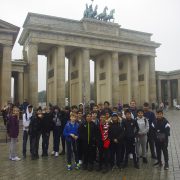
From 23-26 October 2019, 25 HGS students (from Years 8-11), together with Mrs Hartt and Messrs Jones and Campbell, were on a Science and History trip to Berlin, Germany. There, we learnt about the history of Berlin during the Cold War and what life was like in East Germany under the Communist regime. We visited the Deutches Technikmuseum, Sachsenhausen concentration camp, which is not far north of Berlin, and the Olympiastadion.
We met up at Birmingham Airport and flew with FlyBe to Berlin Tegel Airport, where we boarded a coach before heading to our accommodation. There, we dropped our bags off and went to the Greek restaurant which was next to the hotel for a late dinner.
On the first day, we took the S-Bahn to Potsdamer Platz to begin a walking tour of Berlin. Potsdamer Platz was totally destroyed during WW2 with nothing left standing. It has had to be rebuilt and it is now full of very modern skyscrapers. In Potsdamer Platz there are still parts of the Berlin Wall left to look at and a cobblestone trail of where the wall used to be. From there, we crossed over to what was East Berlin. You could see the significant change from east to west, with buildings being split and how buildings on either side of the wall looked totally different. Then we saw where Adolf Hitler had committed suicide and been burned. This was at the site of his former underground bunker where he had controlled Germany during WW2. From there we went to the Brandenburg Gate, which was the main gate in and out of Berlin. Next, we saw the Reichstag, which was a beautiful building built in 1894 for the German Parliament. We then left our great tour guide and boarded a boat which took us along the River Spree. From the boat we could see the many different sites of Berlin, old and new, which were very interesting.
After that, we went to see the largest remaining section of the Berlin Wall (at Bernauer Strasse) and found out about the history of how the wall had separated communities and how many people had died trying to cross from east to west for a better life. After walking along the wall and seeing the church that had replaced a previous one which was burnt down by the Russians, we went to the DDR museum which showcased what life was like for East Germans under Communist rule. It showed us how difficult it was to live there with freedom of speech abolished and only one type of car available (The Trabant)! After that, we explored Alexanderplatz before going for our evening meal at the Route 66 restaurant and, finally, we enjoyed a session of bowling before returning to our hotel after a full and tiring day.
The next day we visited the Olympiastadion which was built for the 1936 Olympic games. We were told that it had retained its original outer ring of stone but had been transformed on the inside into a modern 74,475 capacity stadium which is used for athletic events and concerts but is also rented from the Berlin Council by Hertha Berlin FC. We toured the facilities including the changing rooms and the first-class lounges where the press conferences are held, and saw first-hand where Hitler had stood to open the 1936 Olympics.
Next, we visited Sachsenhausen Concentration Camp which is located in Oranienburg. It was opened in 1936 and used primarily for political prisoners, but in its later life was used for Jews, Poles and Jehovah’s Witnesses. In total, there were 200,000 inmates, of which 30,000 died. It was liberated in 1945 by The Polish Army’s 2nd Infantry Division. The visit there was very thought-provoking and our guide explained how the Third Reich brutally treated and murdered so many innocent men, women and children who had done nothing wrong apart from being born in the wrong place, to the wrong family or did not accept the ideals of the Nazi Party.
After that, we went to Berlin Science Museum (the Deutches Technikmuseum) and looked at the different scientific exhibits as well as the plane, train and automobile collections on show which were very interesting.
That night we ate at the accommodation before flying back the next day to Birmingham. Overall, it was a fun trip and it was very interesting to learn about the history of Germany as well as Berlin in particular.
Robert Callaghan, Year 10


On 20th November 2019, 10 Year 12 A-level Chemistry students had the honour of attending the annual and much anticipated “A-level Chemistry Live” event at The University of Birmingham. We listened to professional lectures delivered by world-renowned Chemists. These included Dr. Suze Kundu, the brilliant Professor Peter Atkins (a fellow of Lincoln College, University of Oxford and the author of almost 60 amazing reads), Professor Lucy Carpenter, Dr. Peter Wothers (a teaching fellow in the Department of Chemistry, University of Cambridge and a fellow and Director of Studies in Chemistry at St Catherine’s College and the organiser of the annual ‘Cambridge Chemistry Challenge Competition’) and, finally, the thrilling Professor Andrea Sella (an inorganic chemist at University College London who specialises in the synthesis of new materials and compounds). The exciting scientific fields these lectures introduced us to included “Adventures at Nano Scale”, “Energy and Entropy”, “An around the world tour of atmospheric chemistry” and “The Periodic Table”.
We are extremely grateful for the opportunities given to us by the Science Department of King Edward VI Handsworth Grammar School for Boys. Manraj Bansel, an A-level student, writes ‘It was a useful experience as it has opened my eyes to the almost infinite opportunities A-level Chemistry can offer’.
We wish to thank Ms. Bilkhu, our chemistry teacher, who organised this amazing trip and look forward to participating in the annual ‘Cambridge Chemistry Challenge Competition’ for which she has been organising entry for our brightest Year 12 Chemists since 2015.
Dauwood Shaker, Year 12
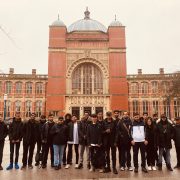
On the 25th November, a group of A-level physicists and some Year 11s went on a trip to the University of Birmingham. We were able to listen to various speakers talking about their particular research interests.
Professor Jim-al-Khalili talked to us about a new breakthrough between the three sciences called quantum biology and how this has led to collaboration projects between students studying at the University of Surrey.
Doctor Jessica Wade from Imperial College gave a lecture on plastic electronics. This relates to our future, using a minimal amount of plastic and being able to print numerous useful things such as solar panels that are paper thin! Furthermore, she discussed the importance of the orientation of the chemical formulae of materials and how this can alter the properties depending on whether they are left handed or right.
Overall the day was very informative and gave a great insight into how varied ‘physics’ is. On behalf of all the students that went, many thanks to our Physics Department for organising the trip.
Rohan Nath, Year 12


On the 2nd of November 2019, Year 12 and 13 students attended talks around the topic of “Computer Science in Action”. This included lectures that demonstrated the leading edge of computer science today, such as conversations about artificial intelligence and programs used in animation. The day also contained tips to help us with our examinations.
Five well-known and celebrated computer scientists from the field of Computer Science came to deliver these lectures, crossing the boundary between information and entertainment. Jon Macey spoke about the computer science behind animation technology, which not only involves a deep understanding of languages like Python, but also elements of physics such as the springs. He spoke about how cloth in animation technology is defined via virtual springs in the fabric.
Finally, Matthew Scroggs talked about his computer MENACE, made from matchboxes; designed to play noughts and crosses. Each matchbox was filled with coloured beads, each representing a different move that the machine could play. It used a version of machine learning in order to improve its playing. Lectures such as these created an inspiring day filled with eye-opening careers that one could take in the field of computer science.
Abhishek Dey

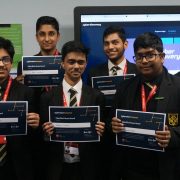
Congratulations to seven of our year 12 Computer Science students who all scored maximum marks in the recent Cyber Discovery Challenge, a HM Government-funded extracurricular programme, turning teenagers into cyber security experts. This is an integral part of the UK’s national cyber security strategy and aims to develop the next generation of cyber professionals. They were selected from over 35,000 students to take part in the Cyber-Start complete bonus challenge, aiming to solve an online capture the flag competition. All students are working as hard as they can to reach the final stage of the competition, completing digital forensics, cryptography and binary exploitation tasks which are skills needed in a real-life cyber security expert’s job.