Fasting in Ramadan

Some of you will start a month of fasting for Ramadan on Monday 12 April 2021 (subject to the sighting of the new moon).  This is, no doubt, a special time for you and your families.  It is great that you are showing such dedication to your faith and keeping hold of a traditional practice that many other faiths also recognise.  Part of the purpose of the month is to bring people and communities together.  Although this year Ramadan might feel a little different with some of the restrictions in place, we still hope that the month brings you much happiness, benefit and increase.  Please do remember, however, that your commitment to school and your education needs also to continue.  To help you with this, a few practical tips/reminders follow:

  1. The summer fasts and long days will require you to go without food and drink for a long time. You must be best prepared for this by making sure you take something of good nutritional value in the pre-dawn meal before you close and make the intention to fast.  Cereals, yogurt, dates, wholemeal bread, vegetables, fresh fruit are amongst some of the healthy/slow release carbohydrate foods that will keep you satisfied for longer.
  2. Following on from this during the school day avoid running or standing around in the sun. Try to find some shade and occupy yourself in low energy activities.
  3. It is very important that you continue to come to school prepared to learn. Lessons will happen as normal.  Your teachers may make slight adjustments in some of the practical subjects for you but you should come fully prepared to take part with the correct equipment/kit.
  4. In the same way you must also wear the correct school uniform. Obviously when it is very hot, you may be allowed to take your blazers off, your form tutors will advise you about that.  However, some students during Ramadan feel that they need to wear mosque caps/hats.  We understand that this may be recommended at certain times/places but it is not a religious requirement for you to wear these in and around school.
  5. The real significance of this month is about self-discipline and working on improving your character. It is not just a case of going without food for long hours.  Working on honesty, truthfulness, charity, forgiveness, respect etc… are some of the positive character traits that become the focus of this month.  This is something that the school whole heartedly supports and we hope that in some way we can all benefit from this.
  6. With the shorter nights, long days and late night prayers many of you will only get about 6 hours of sleep every night but you will still be expected to attend school punctually as normal. Therefore some readjustment to your routine will be needed to help with this.  Like in some traditional cultures you should try to catch up on some sleep after school in order to re-energise for the rest of the day/fast.  It might take a few days for this to settle but it is a sensible way forward.
  7. It is also the case that many of you will be taking important internal exams during Ramadan. While we wholeheartedly support your commitment to fasting, we also ask you to uphold the duty of taking these exams seriously, sensibly and with the best of effort – educational success is also something important to the religion of Islam.  During the exam period, it is crucial that you develop a positive routine around fasting, prayers, revision and the taking of exams.  Remember also if you are not feeling well then there is the chance of making up the fasts at a later date.  Islam does not require one to place hardship, unrealistic aims or one’s future in jeopardy.  Similarly, if you become unwell whilst you are fasting then you should end the fast by taking some water.  In such situations Islamic rulings allow the breaking of a fast, this can also be made up at a later date.  There is also the prospect of offering the late nightly prayers at home rather than the mosque before an exam day, allowing you to get more sleep to feel fresher for the examination.  It will be a good idea to have a very intense revision period before Ramadan begins, this will ease some of the pressure and perhaps allow for a more strategic schedule during the month itself.
  8. When it is very hot, it is obviously important that you remain hydrated but without food or drink. This is a challenge which most of you will have experienced having fasted in previous years.  Small things like washing your hands with cold water, wiping over the face/head with cold water will help keep you cool.  This should be done at break/lunchtimes.  We don’t want students constantly out of lessons unless it is absolutely necessary.
  9. If you are unwell and unable to attend school then you should follow the normal absence procedures. Ask your parents to phone the front office and inform them on the day about your circumstances preferably before 8:40am.
  10. Remember also that one of the strengths of HGS is the broad cultures and faith groups represented in both our student and staff populations. This is something quite special for the School.  So while those of you who fast will need time/space to practice your faith please do remember that the Dining Hall will remain open and most people will continue to eat and drink throughout the day and they too will need time/space to do so!
  11. We ask students to do their prayers when they get home after school. Due to COVID-19, there will not be enough time or socially distanced space during KS3 or KS4 lunch to do prayers on site.  You will have plenty of time to complete the afternoon prayer when you get home.

We wish you a happy and prosperous Ramadan.  If you do have any further questions or comments then you are welcome to speak to Mr Mohammed (room 10).

Focus on Education March 2021 No. 5

Following International Women’s Day, and after celebrating Mother’s Day recently, the horror that our nation felt upon learning of the abduction, disappearance and murder of Sarah Everard cannot be understated.

The news that a woman, who was walking by a main road during the evening on well-lit streets, could disappear only to be found under a week later in remote Kent woodland in a builder’s bag, discarded like rubbish, is a crime so heinous, so appalling, that many people simply cannot comprehend it.

What can be taken away from this tragedy that isn’t shock at its barbarism and evil, is how the subsequent events have empowered women and men to address issues surrounding the use of language to frame debate. It has once again shed light on how our society is in many ways institutionally sexist, with male chauvinism permeating many facets of our public life and debate. It has enlightened many of us in the way that some elements of society express how women are framed as having bad things done to them, that violence towards women – including rape, murder and kidnapping – is a woman’s problem, theirs to deal with. It never seems to be about how men are the perpetrators.

A TED talk by Jackson Katz summarised it superbly. He said ‘“We talk about how many women were raped last year, not about how many men raped women. We talk about how many girls in a school district were harassed last year, not about how many boys harassed girls. We talk about how many teenage girls in the state of Vermont got pregnant last year, rather than how many men and boys impregnated teenage girls.

“So you can see how the use of the passive voice has a political effect. [It] shifts the focus off of men and boys and onto girls and women. Even the term ‘violence against women’ is problematic. It’s a passive construction; there’s no active agent in the sentence. It’s a bad thing that happens to women, but when you look at that term ‘violence against women,’ nobody is doing it to them. It just happens to them…Men aren’t even a part of it!”

But men are part of it. Men are more than part of it. Collectively, men are the problem and bear the responsibility. No one should be a victim, but more importantly there should not be any perpetrators. And the facts speak for themselves: when it comes to murder, kidnapping and violence, 90% of all murders are committed by men, as are 97% of sexual offences.

We have to talk about this openly in our school and in our community.

The issues are absolutely not about any individual boy in this school or male member of staff. It is definitely not saying or alleging that everyone who is male is a closet kidnapper, rapist or murderer. No. It’s about how society collectively, the society and establishment of which I and every other male member of staff is a member, has by its actions – and more significantly inactions – enabled some men to harm women, not necessarily the harm which Sarah Everard had to endure in her last hours alive, but harm that has far reaching consequences and causes untold emotional damage.

Some of you may think it is not common place? It is another town or country’s problem? Think again. If any of you have read social media the last few days you find post upon post of brave women speaking out about misogyny and sexism, and downright abuse, on a daily basis.

Kate McCann, the political correspondent at Sky, shared her experience: ‘What happened to Sarah Everard has hit home hard for so many women because we make the calculations she did every day too. We take the longer, better-lit route, push the fear aside for the voice that says ‘don’t be daft, you’ve every right to walk home alone at night and be safe. Tell friends ‘it’s fine, it’s just around the corner, I’ll text when I’m back’ …but still we make a plan – Keys gripped between fingers we map the corner shops we could duck into en-route. Swap shoes for trainers in case we need to run. Keep our music low or turned off. Even being on the phone has downsides. One eye is always on the person in front or behind – would they help me, might they be a threat? Should I cross the road, would that make it worse? Are there lights on in any of these houses if I need to pretend this is where I live? You’re a grown woman and in no other area of your life do you feel so vulnerable. You resent it even though you understand there is a risk – however small. It is frustrating and tiring and constant. And yet sometimes, despite all those calculations, it still isn’t enough.’

This fear and trepidation that women in our society live under is not right or sustainable. It cannot be allowed to continue – we have to see change and fast. This behaviour cannot be normalised, and it cannot be accepted.

Off the cuff remarks and comments which are made seemingly in jest or as part of banter in school can be demeaning and do damage. Is it solely a problem for HGS?  No. Most definitely not.

It is happening in every school in every part of the country. Yet many schools would not admit to it. Many schools are not brave enough to do so. We are.

And the only way we’re going to make sure it stops is to confront it, and face this challenge together.

If we allow and accept comments, cat-calling, sexist observations, and don’t shout it out and at the same time shout it down, then sadly, collectively, the males in this school are culpable of propagating a culture that will end up with such behaviour continuing to be the norm, behaviour that has far reaching and – if it reaches its zenith – tragic consequences.  That simply is not good enough.

Let’s start by framing the debate correctly.

The headline is not ‘Drunk girl raped after night out’ but ‘Man rapes women’.

The headline is not ‘33 year old women kidnapped and murdered’ but ‘Man commits murder’.

The headline is not ‘Safety of women needs to be addressed’ but ‘Behaviour of men needs to change’.

Let us use this tragedy as an opportunity for HGS and our community to address this head on.

Let us use this tragedy to collectively change our own narrative.

Let us be a force for good.

Stay well and safe.

Be kind to yourself and each other.

Dr Bird

ELE Success

Gaurav Dubay, Head of English at King Edward VI Handsworth Grammar School, was successful in being appointed as an Evidence Lead in Education (ELE) with the Education Endowment Fund. The application process is a rigorous and gruelling one, and very few candidates are successfully designated as ELEs.

ELEs are experts in using evidence and research to inform classroom practice. They contribute to wider educational training, combining their knowledge, interpersonal skills and coaching skills to help make evidence based practice a reality in schools across the country.

Although the role has a wide focus, ELEs are practicing practitioners and their concern is applying, analysing and evaluating evidence based practice within their setting and the MAT. The role fully supports HGS’s vision in embracing the ‘transformative power of education’ and in inculcating ‘a love of learning and intellectual curiosity’ in all students. Gaurav has already contributed to a wider reading project, oracy for learning, and disciplinary literacy, in his role as an ELE.

If you would like more information about the post and how it could benefit your school, please contact Gaurav on 0121 554 2794 or GDubay@handsworth.bham.sch.uk

Focus on Education March 2021 No.4

It has been so good to have all our students back in school again, and for the corridors to resound with their happy chatter. We have been impressed by their ready willingness to comply with additional measures to keep both our own and the wider community safe, and we are desperately keen to keep them all in school until the end of term.

As part of this return and as part of our wider focus on Wellbeing and the importance of good Mental Health is our monthly reference to the Action for Happiness Calendar. This is displayed on our website and the screens around school as well as being referenced in Assemblies and Form time in conjunction with specific activities, which enhance Mindfulness. Examples of this have been our Lockdown Games, our celebration and raising awareness of Children’s Mental Health Week, our assembly on Kooth https://www.kooth.com/ and the Mental Health Spectrum, and our promotion of Walking for Mental and Physical Wellbeing. Students are now also together enjoying PE, Games and aspects of the more practical subjects in which it has been more difficult to participate at home.

Whilst we continue to aspire to academic excellence and a broad and balanced education, it is vital too that we hone the skills and confidence of our staff in their support of students’ mental health and wellbeing. Staff have received an introduction to Wellbeing and Mental Health Awareness as well as updates as part of our annual CPD programme and our Wellbeing Action Plan. A number of staff have undergone Mental First Aid training, Anxiety support training and Bereavement and Loss training. We are also looking at other CPD and training courses for next academic year through BEP (Birmingham Education Partnership) and via SSS Safeguarding, Training and Assessment.

I would also draw your attention to the ten keys for happier living. This links into our educational philosophy of BLH (Building Learning Habits):

GREAT DREAM – Giving, Relating, Exercise, Awareness, Trying out, Direction, Resilience, Emotions, Acceptance, Meaning.

Please also check out our website at: https://www.handsworth.bham.sch.uk/about-the-school/wellbeing/

All of this reflects our wholehearted and proactive commitment to developing our students as well-rounded human beings – healthy in mind, body and soul – and to supporting and equipping them and their families for life’s challenges. Having a healthy mind is just as important as a healthy body.

Stay well and safe.

Be kind to yourself and each other.

Dr Bird

Tropical Fish Club – Week 1

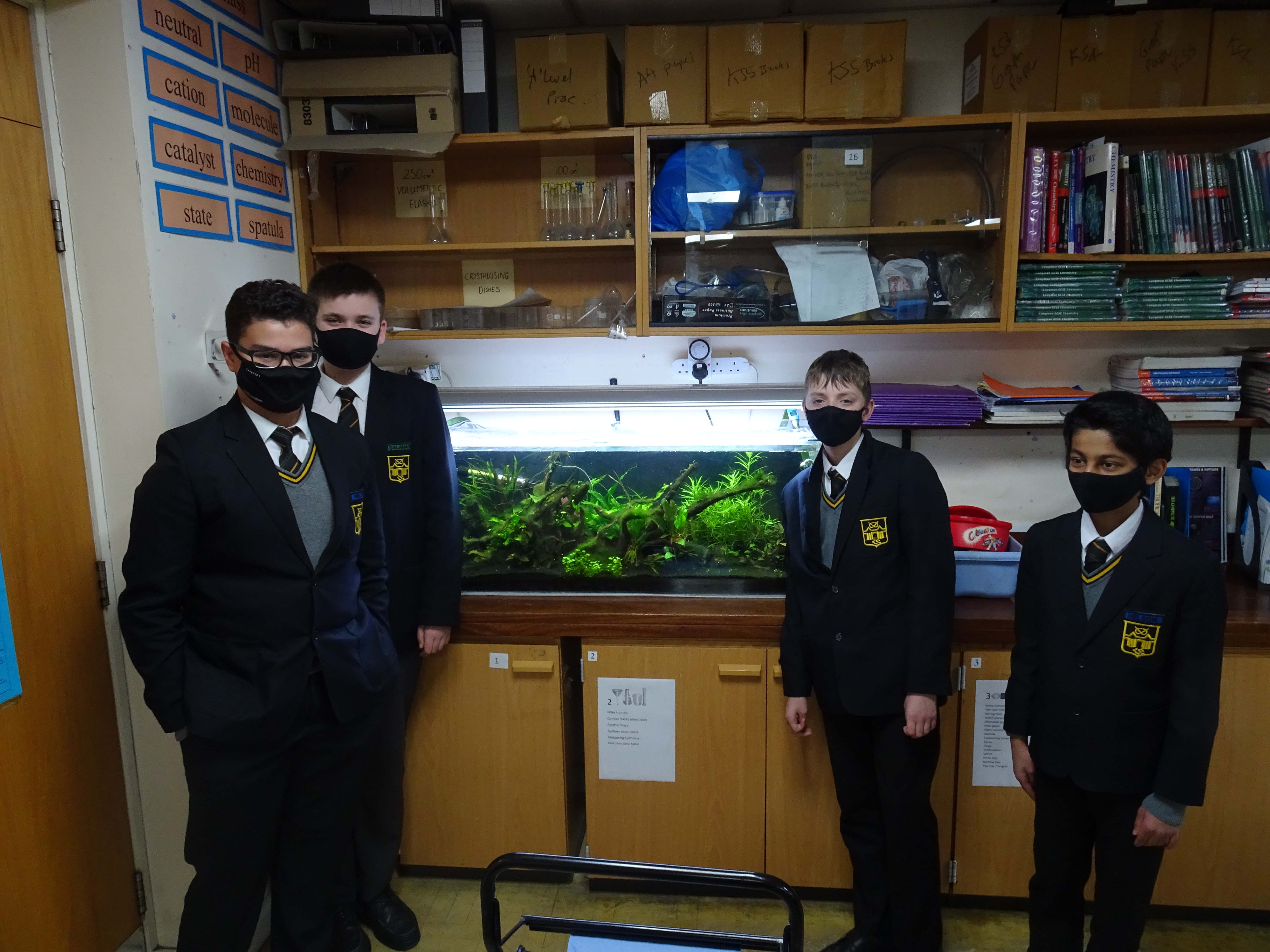
We got together for the first time this week and talked about our past/current experiences with pet care, what we would like to get out of the club and what our vision/plan is for the project. We decided that we would aim to create an environment mimicking nature – a heavily planted tank which would provide us with opportunities to learn about photosynthesis, the role of nutrients and much more. We also discussed how this would provide safe environments for the fish and this in-turn reduces levels of stress they can suffer from.

We also talked about our existing ideas/thought of what an ideal ‘fish tank’ should look like. Pupils drew their ‘ideal’ aquarium and we discussed how we would like it to be low maintenance, everything within it ought to be healthy, good-looking and provide us with a relaxing view. We took inspiration from pictures of planted aquariums online. We discussed how this type of scape is relaxing to view compared to the stereotypical kids’ aquarium; decorated with colourful gravel and artificial ornaments containing barely any plants or plastic ones!

We have been lucky enough to have received some booklets on basic aquarium care from one of the largest aquarium product manufacturers in the world, Tetra! [1]. Dave Wardle from Tetra kindly posted us these guides for pupils, which will provide our members with some extra background reading.

Next week we look forward to learning about the different types and species of aquatic plants. How we can create visual depth, provide hiding spaces/safe spaces for fish and how we can use materials to achieve a natural aesthetic.

[1]: https://www.tetra.net/en-gb


Week 9 & 10

Week 8

Week 7

Week 6

Week 5

Week 4

Easter

Week 3

Week 2

Week 1

Introduction


Focus on Education March 2021 No.3

In January, Nepalese climber, Nirmal Purja accomplished one of the most coveted achievements in mountaineering – the first winter ascent of K2, the world’s second highest mountain. It is the only one of the 8000s, that is, the 14 mountains in the world over 8000m that has never been climbed in winter. There is good reason, for at 8611m, it is only marginally lower than Mt Everest, but is far more technical, and far more unpredictable in terms of extreme weather.

Near the summit, it is not uncommon for the air temperature to reach – 65⁰C, and winds of hurricane force. Above 8000m climbers enter the death zone, so called because there is so little oxygen in the air that the human body is in a state of continuous deterioration, and where you can only survive for a limited amount of time. There have been six previous attempts to climb K2 in winter, all of which failed, and many considered it an impossible challenge.

Unbelievably, Nirmal is not the most experienced mountaineer, having only started climbing at the age of 29. He grew up in western Nepal, one of the world’s poorest countries. He often had no shoes and his family would sometimes walk to a neighbour’s house at the weekend so they could share their television.

His early dream was simple, to join the Gurkha Regiment of the British Army. Every year 28,000 Nepalese men apply for 200 places in this highly respected regiment. Nirmal succeeded in his goal, and after six years, he became the first Gurkha soldier in more than 200 years to pass selection for the elite, Special Boat Service, or SBS.

It was with the SBS that he took up mountaineering and in 2016 he climbed Mt Everest. He repeated his ascent in 2017, before attempting the record for the fastest ascent of all the world’s fourteen 8000m peaks. He called the endeavour ‘Project Possible.’

The record stood at seven years and 10 months. The height gain is equivalent to climbing vertically from sea level to the edge of space. No one believed this was possible and he was even mocked by many seasoned mountaineers. But on the 29th October 2019, he reached the final summit, in a remote region of Tibet, having climbed all the 8000s in an incredible 6 months and 1 week!

At first glance Nirmal’s astonishing achievement seems a solo effort, a phenomenal feat accomplished alone. But it is not, and it required a big team effort. In January, he entered the record books becoming the first person to summit K2 in winter. Upon reaching the summit alongside his fellow climbers, they sang the Nepalese national anthem, and in a statement said“What a journey I am humbled to say that as a team we have summited the magnificent K2 in extreme winter conditions – we have shown that collaboration, teamwork and a positive mental attitude can push limits to what we feel might be possible.”

So, what are the qualities of a mountaineer and what can we learn from them and apply to our daily lives?

Humility is a quality that stands out in the Sherpa community, and was evident in some of the early mountaineers.

Sir Edmund Hillary, who along with Tenzing Norgay became the first people to reach the summit of Mt Everest on the 29th May 1953, held the Sherpa in high regard. Without the Sherpa, Hillary and Tenzing would not have reached the summit. But, Hillary, Tenzing, and expedition leader, John Hunt embodied humility.

 “It is not the mountain we conquer, but ourselves.” (Hillary)

 “You cannot be a good mountaineer, however great your ability, unless you are cheerful, and have the spirit of comradeship. Teamwork is key to success, and selfishness only makes a man small.” (Tenzing)

The first British climbers to summit Everest were Doug Scott and Dougal Haston. In the 1975 expedition led by Sir Chris Bonnington, one of Britain’s most successful mountaineers, Scott and Haston followed the much more challenging and previously unclimbed south west face.

Forced to camp the night in a snow hole just below the summit at 8750m, a feat that no climber had ever previously survived, they demonstrated huge resilience when faced with adversity. Scott and Haston’s success, was founded on strong teamwork and the humble approach of the supporting Sherpa. With no mobile or satellite phones, the climbers were cut-off from the outside world. Success relied on the climbers working together, facing uncertainty together, but above all, caring for each other. The Sherpa also recognise that being co-operative rather than competitive is a preferable state for survival in a hostile mountain environment. For Scott, being the first to summit a mountain was not important. What mattered, was the how. He relished the journey, prioritising curiosity, personal responsibility and a willingness to embrace uncertainty.

 John Hunt was asked whether climbing Mt Everest was worth it, and he replied:

“Ultimately, the justification for climbing Everest, if any justification is needed, will lie in the seeking of their Everest’s by others stimulated by this event as we were inspired by others before us.”

As we continue to face the uncertainties in this pandemic, we can look out for each other. We can display humility, resilience, strong teamwork, and we can care for each other. We have the ability to seek out our own Everest’s and conquer them together as a community. A strong community that we are – each and every one of us being an important part of it.

Haec Olim Meminisse Iuvabit

Stay well and safe.

Be kind to yourself and each other.

Dr Bird

Focus on Education March 2021 No. 2

I remember a wise colleague telling me when I first became a head that one of the most important things I would do would be appointing new staff.

This time of year is always busy for recruitment in education as we consider timetable needs and seek to replace the valued members of our team who are leaving – for reasons of retirement, promotion or relocation. We are fortunate to attract strong fields and I have been especially heartened to see top graduates training for the profession and now seeking employment.

I often ask young recruits whether it is a love of the subject or a love of working with young people, which is more important and whether this is the first of several careers or a vocation. Passion for our subject is of course vital, as we aim to inspire and to challenge, but it is the enjoyment of working with children and seeing their immense potential, which trumps everything else. And that, for most teachers, is still a vocation.

As a teacher and headmaster, I have been privileged to work with some very gifted and amazing people (both teaching and support staff) who care deeply for those in their care. Never has this been more apparent than during the last year when so much has been asked and so much given. A head can have an exciting vision and all sorts of wonderful ideas, but he or she is wholly reliant on the support and dedication of his or her staff for their realisation. I see my role as enabling the best from the staff, whilst also doing my best for them.

The success of a school depends so much on the quality of relationships within its community: between the staff, at all levels; between the staff and the students; between the students themselves; and with their parents. As staff, we role model those healthy and productive working relationships, and mutually supportive colleagues in turn support their students. Happy staff = happy students is no facile equation.

Whether teachers or support staff, we all share a common goal: to make the school experience as good as it can be for our young people and to give them the best possible start in life. We want them to be world-changers and a force for good! Therefore, I am very grateful to all staff for the way we have gone about testing both on Friday last week and today so that we can ensure a safe return to school for all our community at HGS.

Stay well and safe.

Be kind to yourself and each other.

Dr Bird

Wellbeing Advice

Focus on Education March 2021

We seem to be heading in the right direction! Let’s really hope that those words “cautious” and “irreversible” will be the theme of the next few weeks as different aspects of society gradually re-open.

We are truly delighted that children’s education has been prioritised and that we can welcome all our students back to school next week. Now that we are permitted to conduct some testing before  March 8th, it is exciting to know that our corridors will again be filled with happy chatter and purposeful activity from 8.30am on that Monday.

We do not underestimate how important that moment is. Students (and staff) have risen with impressive resilience and good humour to the challenges, and they have continued to make some excellent academic progress with their teachers via remote learning. However, they long to see their friends, to play team sports again, to make live music with each other and to benefit from some of the spontaneity that is missing when you have continually to mute and unmute (and to remember to do the latter!).

We have done our best to sustain a sense of positive and active community, even whilst apart – as is amply reflected in our Assembly programme, Games programme and other communal events and opportunities. Our students’ well-being is every bit as important as their academic progress, as they will not anyway flourish in their studies without a feeling of self-worth, value and belonging.

So, as we re-open, we shall be very aware that some may be anxious about returning to school after this second long lockdown. It will be really important that students again follow guidance very carefully as we observe social distancing measures wherever possible and carefully consider each other’s needs and feelings.

Please do not hesitate to contact your son or daughter’s Form Tutor if you have any concerns, before or after 8 March. We are keen that the final weeks of term should be as productive and happy as possible.

With the good news about vaccines, blue skies above us, and bulbs beginning to bloom, the outlook is suddenly far rosier and refreshing.

Stay well and safe.

Be kind to yourself and each other.

Dr Bird

An open letter from Education Secretary Gavin Williamson

Please see the following open letter from Education Secretary Gavin Williamson to parents, carers and guardians:

An open letter from Education Secretary Gavin Williamson to parents, carers and guardians – Education in the media (blog.gov.uk)